
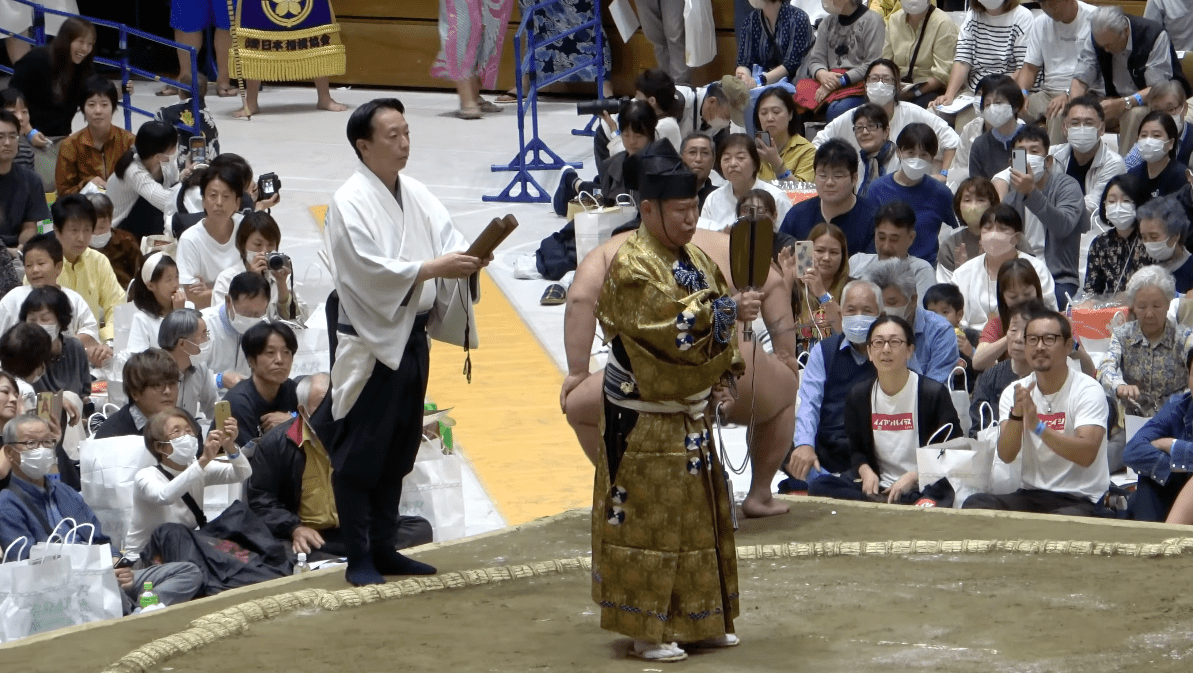
In the final bout of Day 13 at the Natsu Basho earlier this month, the 39th Kimura Shōnosuke (sumo’s chief referee) pointed his gunbai (war-fan) to Kotoeiho. A mono-ii (post-match review by ringside judges called shimpan) was called. The shimpan conferred, reversed him, and gave the win to Kirishima on an utchari—a backward pivot-throw at the edge in which the loser is dragged down a fraction before the thrower’s own exit. It was his first gunbai-sashichigae (reversed call) as tate-gyōji, and the first such miscall by a chief referee in over a decade. Later, Kimura reported the matter to JSA Chairman Hakkaku, an act custom reads as a conditional offer of resignation. The chairman declined it, urging him to remain in his post.
Reading this event as pure sport, it’s an interesting footnote worthy of inclusion in a sumo trivia competition. Reading it as form, however, it is a natural experiment in the metapragmatics of an embodied institutional sign system. It is a rare moment when sumo’s apparatus operates on itself in public, revealing the seams of its semiotic and historical construction.
The Gunbai as Spatial Index and Conditional Proposal
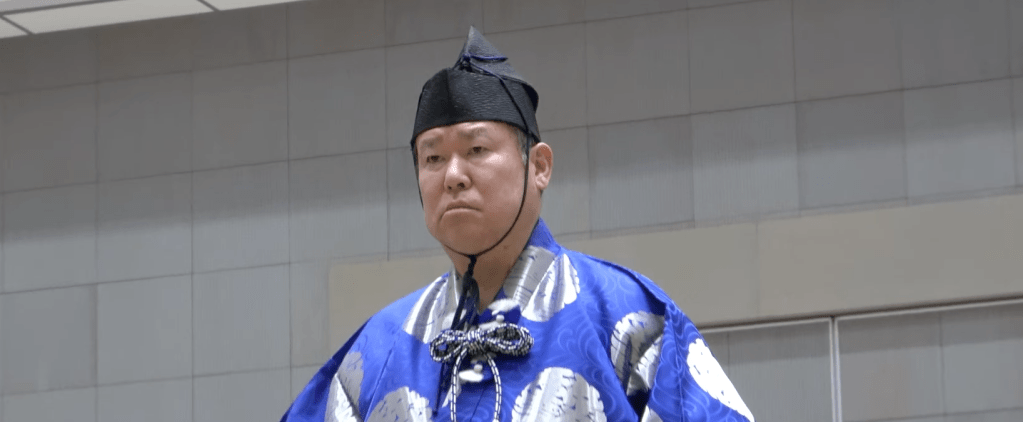
The referee’s gunbai does more than just report who wins a given bout, it attempts to ‘make’ one combatant the winner. Its declarative power, however, derives entirely from its function as a spatial index. It physically points to the East or West side of the dohyō, generating an indexical vector.
Furthermore, the gyōji’s gesture possesses immediate illocutionary force (it names the declared winner to the audience), but its perlocutionary effect (ratifying the victory and officially ending the bout) is definitively suspended. Because the gyōji is expected to give a clear decision without delay, he must produce a decisive mark that identifies the winner instantly. Therefore, the gunbai is not an absolute declaration but a compulsory sign-vehicle, i.e., a conditional proposal of state change that requires immediate institutional uptake by the shimpan (judges) to become “happy” or felicitous. The form requires an unambiguous indexical proposition first, followed by adjudicating its epistemic accuracy second.
The Mono-ii as Metapragmatic Spatial Hierarchy
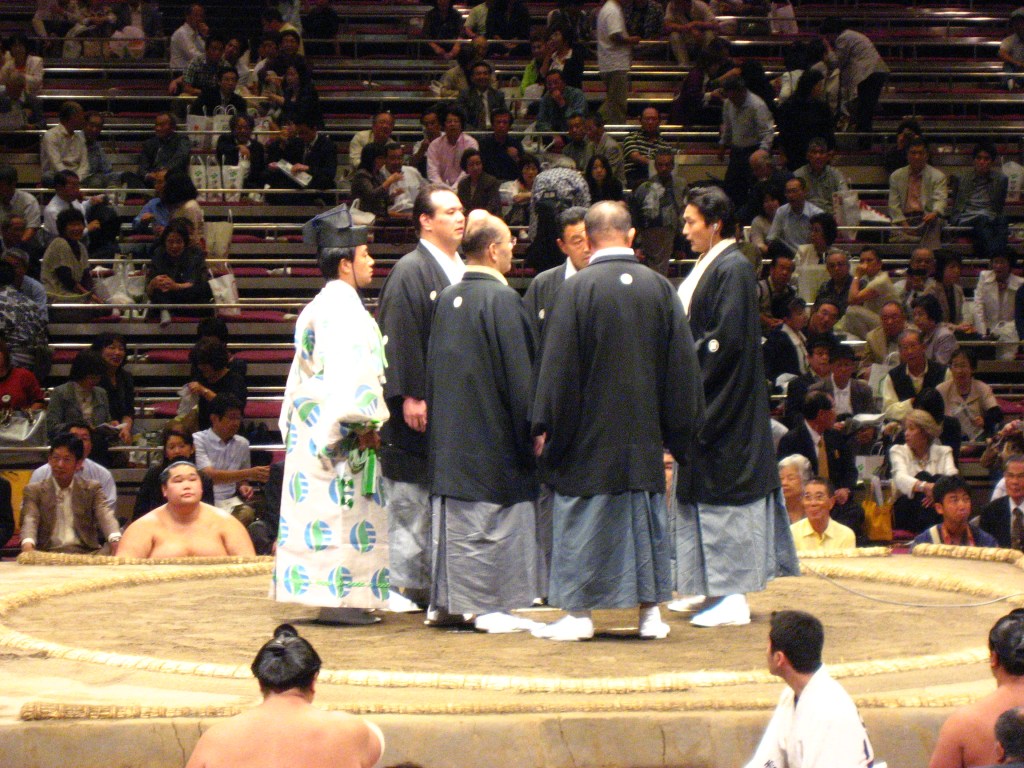
The judges’ conference (mono-ii) is the institution speaking about its own speech. The point of the fan is a first-order pragmatic act, the in-ring huddle is the second-order metapragmatic frame evaluating and correcting the initial declaration.
This repair implements spatial semiotics for implication. During the mono-ii, the shimpan physically enter the sacred space of the dohyō and form a deliberative circle–including the gyōji. He is present but silent, incorporated into the huddle without deliberative standing. Rather than staging the hierarchy through spatial exclusion, it is staged through the more precise instrument of voicelessness, i.e., the gyōji occupies the circle as its subject rather than its agent. Epistemic authority resides with the oyakata (wrestler-elders); the ritual specialist is present to receive the judgment, not to contest it.
While the repair appears seamless and non-coercive to the audience, i.e., functioning as institutional face-work, it is highly coercive internally. The gyōji is subjected to a public display of subordination, enforcing the historical shift of power from the independent gyōji families to the Japan Sumo Association’s (JSA) corporate authority.
The Tantō as Simulated Index and Enregistered Form
Each tate-gyōji carries a tantō (short sword) in his obi (kimono belt). The standing narrative is that the dagger marks his readiness—and willingness—to commit seppuku (ritual suicide) for a wrong call. If we read the sword’s blade as a “frozen index” of unbroken Tokugawa-era martial continuity, we are clearly in the realm of official mythic script rather than straightforward social history.
In contrast, gyōji were low-ranking retainers who lacked the samurai privilege of seppuku. The distinction highlights the societal hierarchy of the time, keeping noble class privileges out of reach to ‘commoners’. The tantō itself is an “invented tradition” that was firmed during the Meiji era to align sumo with State Shinto and the newly constructed kokugi (national sport) ideology. Subsequently, the tantō operates as a simulated index that enregisters a specific, idealized samurai ethos to retroject antiquity and manufacture institutional gravity.
The conditional resignation is the pragmatic uptake of this enregistered sign. The sword has been decontextualized from literal martial violence and recontextualized into modern administrative procedure. The visual symbol of lethal obligation is translated into a bureaucratic verbal report to the chairman. The locution and its uptake have come apart, sustained only by the institution’s curated citation of its own invented (or curated) past.
Professional Vision and Cyborgian Hermeneutics
The substance of the dispute was the physical body of both rikishi. Did Kotoeiho touch down before Kirishima stepped out? The gyōji‘s stated defense that the bodies had not separated was a real-time indexical reading of physical form–without mediation or deliberation. The shimpan‘s reversal was a competing reading of the same milliseconds.
This is not merely a matter of phenomenological embodiment, but a demonstration of socially organized “professional vision.” The shimpan are engaged in a forensic visual perception, translating raw somatic movement into institutional data points (e.g., shini-tai or “dead body” rules).
Furthermore, this hermeneutic process is technologically augmented. The shimpan are not solely reading the physical bodies in the ring. Their sensory apparatus is extended via an earpiece connected to the video review room, a system sumo introduced at the May 1969 tournament after public outcry over a controversial reversal in a Taihō bout earlier that year. The gyōji’s unmediated human reading is overruled by a technologically enhanced epistemic apparatus. Because the JSA’s “unbroken order from antiquity” relies on modern broadcast technology to resolve somatic ambiguity, the interpretive process can be read as cyborgian in Haraway’s sense rather than as purely traditional.
Error as a Demonstration of Order
During a mono-ii, the gyōji is doesn’t look at or consult (in any manner) instant-replay video screens. The shimpan, do consult instant-replay monitors (albeit via earpiece).
If the gyōji looked at a screen, he would visually register as a modern sports referee, shattering the enregistered aesthetic. The visual grammar of antiquity remains unbroken preciesly because he remains unchanged, even during a technical system repair. The institution metabolizes the error into a display of seriousness. The reversed call does not threaten the claim of unbroken form; handled correctly, it ratifies it.
This single bounded event delivers the convergence of the performative sign, the metapragmatic repair, professional vision, and simulated indexicality. The JSA manufactures its external legitimacy without coercion precisely by utilizing highly formalized internal coercion, i.e.,the public overruling and conditional resignation of its highest ritual official. The reversed gunbai is the moment the form stops being seamless and admits, briefly, that it is a form. And it’s that admission that is precisely what makes it readable.
References & Inline Sources
Theoretical Frameworks:
- Agha, Asif. (2007). Language and Social Relations. Cambridge University Press.
- Austin, J.L. (1962). How to Do Things with Words. Oxford University Press.
- Bauman, Richard, & Briggs, Charles L. (1990). “Poetics and Performance as Critical Perspectives on Language and Social Life.” Annual Review of Anthropology.
- Csordas, Thomas J. (1993). “Somatic Modes of Attention.” Cultural Anthropology.
- Cuyler, P.L. (1979). Sumo: From Rite to Sport. Weatherhill.
- Goffman, Erving. (1955). “On Face-Work: An Analysis of Ritual Elements in Social Interaction.” Psychiatry.
- Goodwin, Charles. (1994). “Professional Vision.” American Anthropologist.
- Hobsbawm, Eric, & Ranger, Terence. (1983). The Invention of Tradition. Cambridge University Press.
- Hutchins, Edwin. (1995). Cognition in the Wild. Cambridge, MA: MIT Press.
- Peirce, Charles Sanders. (1931–1958). Collected Papers of Charles Sanders Peirce. Harvard University Press.
- Silverstein, Michael. (1993). “Metapragmatic Discourse and Metapragmatic Function.” Reflexive Language.
- Thompson, Lee A. (1998). “The Invention of the Yokozuna and the Championship
- System, Or, Futahaguro’s Revenge.” In Stephen Vlastos (ed.), Mirror of Modernity: Invented Traditions of Modern Japan, 174–188. Berkeley: University of California Press.
- Tierney, Kenji. (2010). “The Emperor’s New Clothes: Japanese Sumo and the Invention of Tradition.” Sport in Society.
 Freedom Ahn