I came to Day 1 footage from the Ryogoku Kokugikan already knowing Hoshoryu was injured. I’ve been sidelined with a cold for much of the week, but that much had reached me before I sat down to watch.
Hoshoryu versus Takayasu is always musubi no ichiban (結びの一番) for me, regardless of where it falls in the card. Their chemistry, power, the mutual intensity, the history between them, the balance, it all makes for the very best of sumo every single time. I’ve watched some explosive meetings between these two at the Natsu basho and elsewhere. While Saturday’s bout wasn’t among their most dramatic (like March’s final pairing), it was one of the more painful ones I’ve seen. Hoshoryu’s face got me. Hard.
The moment Hoshoryu went down, something flashed across his features that every athlete who has been seriously injured in competition will recognize immediately. It’s more than the surprise of losing. It’s something colder and more total, an instant, all-knowing awareness of what might have just happened and what it might ultimately cost. The questions start running in a loop: How bad am I? How quickly will I get back? What have I just lost? Has everything just ended? These hit you like lightning. Then comes the moment you choose to move the injury. I don’t care how much of an entertainer someone is; you don’t perform that face.
Any athlete who’s trained for most of their life –I’m a second degree (albeit dusty) blackbelt in TKD–and has been hurt badly enough will recognize it instantly, without commentary.
Natsu 2026 Tachiai
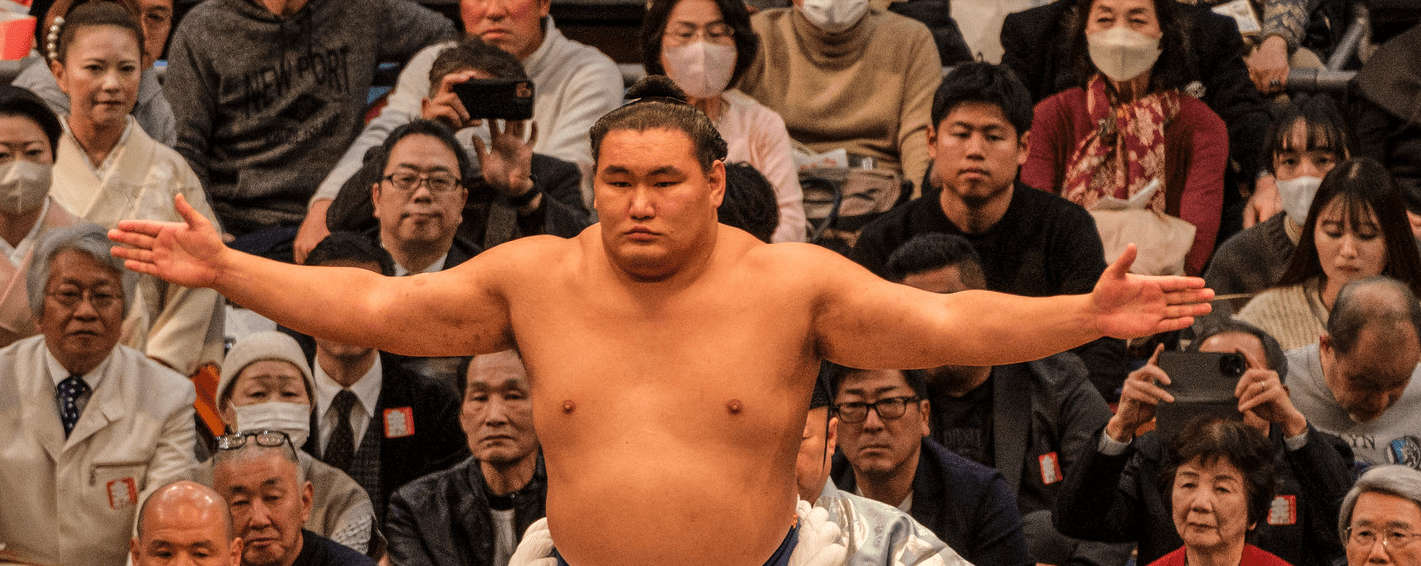
The Natsu 2026 basho opened on May 10th with the upper ranks already showing strain. Onosato is out with a persistent shoulder problem. Newly minted Ozeki Aonishiki is out with a broken toe. Hoshoryu stood as the sole Yokozuna. His was the single body carrying the symbolic weight of sumo’s highest rank into the Summer basho. He lasted one match.
By Day 2, the throne was empty.
What Hinkaku Costs
In sumo, the yokozuna rank sits above ordinary competitive hierarchy. It carries hinkaku (dignity, bearing), that quality of presence expected to be visible in everything a grand champion does, inside the dohyō and out. A yokozuna reigns.
Unlike the ozeki, a rank below him, a yokozuna can’t be demoted for a losing streak. Retirement comes through persistent absence, conduct that undermines the dignity of the rank, failure to embody what the title demands. The JSA awards the yokozuna rank as an honor and the men who hold (or have held) the rank understand the weight of what it actually is.
The rank of yokozuna chooses athletes of extraordinary physical capability and competitive will. Then, it asks these men to keep performing at the highest level of physical and mental demands through damage, through the long ‘endurance tax’ that elite competition levies on the human body.
Hoshoryu has been paying that endurance tax since the first day of his promotion. At the Spring 2025 tournament, he left his yokozuna debut basho with an elbow injury and neck sprain. He withdrew from the Nagoya basho after starting 1-3, making him only the third yokozuna in the modern era to pull out of two of his first three tournaments since 1958. And now, he’s walked out of the Natsu 2026, in a slow, assisted hobble.
Hoshoryu’s injury isn’t an isolated incident. It’s the latest in a pattern that includes Onosato’s shoulder and Aonishiki’s broken toe. It’s a sumo injury crisis concentrated at the very top of the sport.
You Can’t Run Away
Nishonoseki, himself a former yokozuna, spoke recently about Onosato’s situation with a frankness and honesty that cut through the usual institutional language. “I think it’s the hardest thing,” he said. “There’s nothing to do but endure and face yourself. You can’t run away.”
A yokozuna doesn’t have the privilege of lower ranks, to ride out a losing streak and rebuild like recently reinstated Ozeki Kirishima. He can’t even recover without the absence itself becoming the story. Every day the yokozuna isn’t on the dohyō, there’s a new piece of news coverage asking what that absence means for sumo.
When The Yokozuna Isn’t There
The dohyō is an architecturally, ritually, theologically bounded space. The ring has a presiding logic, and the highest rank exists to give that logic its highest human expression. When the yokozuna is absent, the Summer basho proceeds and rituals unfold exactly as expected. But you won’t hear the JSA acknowledging what’s missing, because doing so would require naming a problem with no institutional solution.
The JSA didn’t design this system for the frequency of injury now visible at the top of the sport at almost every basho. Or perhaps the system was designed for an era when men retired before the damage accumulated in front of an always watching public; when their body’s limits and their rank’s demands met on more dignified terms.
Even in that moment of pain and uncertainty, Hoshoryu, unassisted, briefly straightened himself, returned to face the ring and bow out, then returned to lean on his aides to walk down the entranceway, demonstrating the depth of value placed on the completion of the role and not insulting that which bestowed his rank.
 Freedom Ahn